How in the world did they get that patent?!
Have you ever come across a patent that made you shake your head? You wonder how they ever got that patent given all the technologies and products that existed before the filing date. Objections to the validity of patents are not uncommon. Let’s explore what makes a patent invalid and what you can do about it.
Need to challenge a patent? Contact US patent attorney Vic Lin at vlin@icaplaw.com to explore ways to protect your business from invalid patents by competitors.
What makes a patent invalid?
Let’s get a little technical. For utility patents, patent invalidity is directly tied to the claims of the patent. There is no use in complaining about a utility patent being invalid if you are looking at only the drawings and descriptions.
You must go to the claims. To start, focus on the independent claims. For a claim to be invalid, each feature recited in that claim must be found in the prior art.
For example, suppose an independent claim recites three features: ABC. To be invalid, each claimed feature – A, B and C – must be found in the public before the priority date of that patent.
To argue that a claim is invalid is to say that the claim covers something that was already known or obvious at the time the patent application was filed.
How do you invalidate patent claims?
Hypothetical claim sets can help. Take a look at the first claim set below, starting at Claim 1:
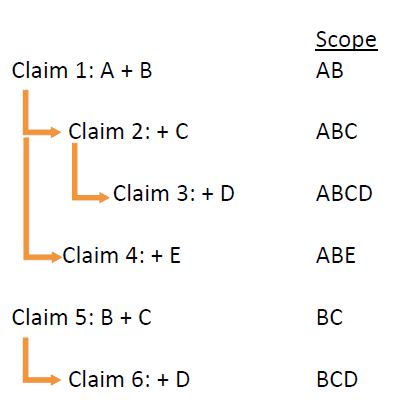
To invalidate Claim 1, which is an independent claim, you would need to find features A and B in the prior art.
Claims 2-4 are dependent claims that ultimately depend on Claim 1. To invalidate Claim 2, for example, you would need to find features A, B and C in the prior art. Logically, dependent claims will add more features or more specific details.
Claim 5 is another independent claim. Since Claim 5 recites only B and C, you would need to find B and C in the prior to invalidate this independent claim.
Notice how the independent claims generally say less. Therefore, independent claims are generally easier to invalidate. Dependent claims add more features and thus become more difficult to invalidate.
How do you search for prior art to invalidate patents?
There are firms that specialize in prior art searches. AI is becoming increasingly useful in searching prior art. In fact, even the USPTO has a pilot program to use AI to search prior art in utility patent applications.
How do you cancel an invalid patent?
Suppose you found strong prior art that ought to invalidate at least one claim in a patent. What are your options in challenging that patent?
One option is to file a request for reexamination with the USPTO. This approach requires a written legal brief detailing how the claims are invalid over certain prior art references. The prior art relied upon must consist of printed publications. You cannot simply allege that you saw something similar in the past.
A substantially more expensive and involved process is to file an Inter Partes Review (IPR) with the USPTO. Unlike a reexamination request, the requestor in an IPR remains involved throughout the process. An IPR is basically a mini-lawsuit between the challenger and the patent owner.
Another way to invalidate patents is to file a claim in US District Court. For a defendant accused of infringement, a counterclaim for patent invalidity may be brought. For an accused infringer who has not yet been sued, a declaratory judgment lawsuit might be an option. Keep in mind that DJ lawsuits for patent invalidty and noninfringement would survive only if there is a case in controversy between the plaintiff (accused infringer) and defendant (patent owner).
Can you use your patent application to invalidate other patents?
Maybe. Initially, your patent application must have an earlier priority date than the patent you wish to invalidate.
The focus should be on your description and drawings, aka the specification. The issue is whether your specification discloses all the elements recited in at least the independent claim of another utility patent.
Can you use your claims to make another patent invalid?
Do not focus on your claims. Your claims are only relevant for determining infringement.
Your claims do not determine the validity of another patent. Instead, focus on your disclosure. You need to start with the features recited in the claims of the patent you wish to invalidate. Then see if all such features are found in the specification of your patent. Do not look for such features in your claims.
Who bears the burden of proving patent invalidity?
Patents are presumed valid under 35 USC 282. Therefore, the burden of proving patent invalidity falls on the challenger.
The patent owner bears the burden of proving infringement. This creates an interesting dynamic in patent infringement cases. You might say that accused infringers have a lower burden in showing noninfringement than in proving invalidity of a patent.