What patents will drive more sales?
Before you can get the right patents to drive more sales, you need to know something critical about patent coverage. It is easier to get narrow utility patents that do not cover your competitors’ products. Broad patents take more work. Good utility patents typically encounter more rejections.
Need patents that will lead to more sales? Reach out to US patent attorney Vic Lin at vlin@icaplaw.com to explore how his experience in obtaining over 1,100 US patents can be put to use for you.
How do you get a broad utility patent that covers competitors?
When it comes to utility patents, it’s all about the claims. You want independent claims that include just enough features to be unique over the prior art without saying too much. Less is more when it comes to utility patent claims.
See this example where Claims 1 and 5 are independent:
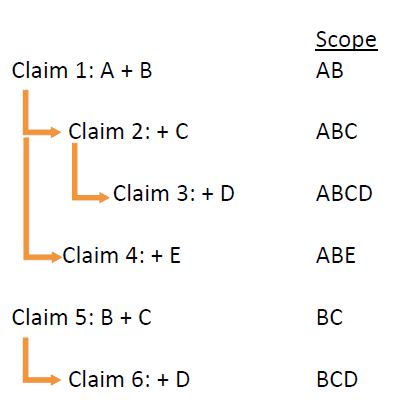
Claim 1 would cover any product that includes at least features A and B. Claim 5 covers any product having at least features B and C. These are examples of very broad claims.
Of course, the USPTO is not going to just allow such broad claims without a big fight. Patent examiners will argue that products with the combination of AB or BC have existed in the prior art.
How do you argue for broader patent claims?
Given that 90% of utility patent applications will receive at least one rejection, you have to temper your expectations when the examiner sends you an Office Action with a bunch of rejections based on prior art references. Does it look like an independent claim reciting only A and B would be allowable?
If not, consider adding features to your independent claims but such claim amendments should strategic. Any additional features added to your independent claims should accomplish these objectives:
- Such features are not shown in the prior art references found by the examiner; and
- Such features are included in your competitors’ products.
Why do patents fail to drive more sales?
Where most patents go wrong is in the second factor above. Features get added to claims that help to overcome prior art rejections, but those features are not included in the competitors’ products. As a result, the patent will fail to cover competing products.
It is not always the patent attorney’s fault. Competitors, especially those savvy in IP, will wait to read your issued patent and then find ways to design around your patent by avoiding certain claimed features.
That is why it is wise to file child applications. Keeping pending child patent applications alive is an effective strategy to pursue new claims against competitors.
Hindsight is Perfect: What can go wrong if you fail to file continuing patent applications?
Referring to the above examples of claim sets, suppose a competitor makes a product containing features B and D. Such a BD product would not infringe Claim 1 because it’s missing A. It also would not infringe Claim 5 because the product omits feature C.
Without filing a continuing application, the patent owner would have no further opportunites to pursue a new independent claim covering B and D. Filing child patent applications gives the patent owner second, third and fourth bites at the apple!
How do you use patents to drive more sales?
Getting the right patents is half the battle. You then need to know how enforce your utility patents cost-effectively. See this post on how to enforce your utility patents on the Amazon APEX patent platform.
The APEX program is not a right given to all patent owners. You must request a neutral patent evaluation, and Amazon has the right to deny any requests.